
Appmilla’s AI-Augmented Development

Why our AI-powered approach delivers more than traditional outsourcing

At Appmilla, we’ve spent the last few years rebuilding how we develop software around AI. This is not as a code-generation gimmick bolted onto an existing process, but as a fundamental shift in how requirements, code, testing and documentation relate to one another. The result is something we think is worth explaining properly: clients working with us don’t just receive a codebase at the end of a project, they receive a development platform they can own, operate and evolve.

Beyond a codebase

The question we keep coming back to is simple: what is a client actually left with when a project finishes? With a traditional outsourced engagement, the honest answer is usually “code, plus some documentation that was accurate on the day it was written.” Our approach is built to leave clients with considerably more.

Our GuardKit toolchain takes loose, real-world requirements and turns them into formal, executable specifications written as BDD scenarios in Gherkin — covering both happy paths and edge cases, with full traceability from business need through to implemented tests. These scenarios double as living documentation: when someone asks “what does the system do?”, the answer is the Gherkin scenarios, verified on every build.

Alongside this sits a domain model built using Domain-Driven Design principles, with bounded contexts for each part of the application. This is not a diagram that drifts out of date, but embedded in the project’s memory and enforced as development proceeds.

Memory

A system that learns

Perhaps the most distinctive part of the approach is that the system has a memory. As a project evolves, architectural decisions, implementation patterns and domain knowledge are captured in a persistent store rather than living only in people’s heads or in documents that quickly drift. Each decision is recorded together with its rationale; approaches that work are reinforced; and approaches that don’t are kept with the context of what went wrong. The system genuinely accumulates knowledge over time.

Verification results feed back into this memory too, giving a live picture of which behaviours are covered and passing. In practice this means a new developer — whether from our team, the client’s, or a future partner — can ask questions like “what authentication patterns have we used successfully here?” or “why was this service designed the way it was?” and get accurate, contextual answers, rather than relying on tribal knowledge that walks out the door when a contract ends.

The AI-powered development pipeline

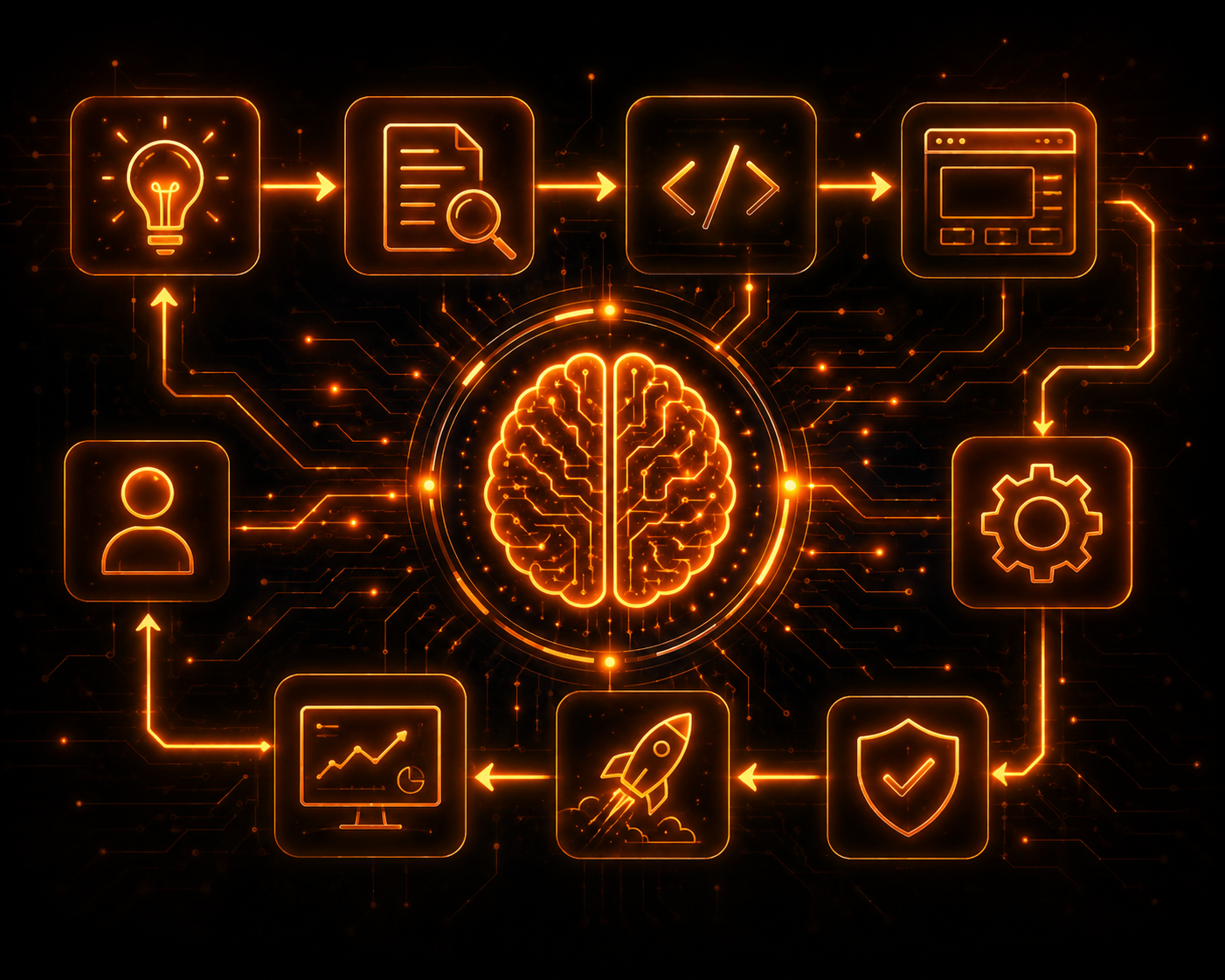
Rather than using AI purely as a coding assistant, we’ve integrated it across the full lifecycle:

  • Specification: loose requirements are turned into a comprehensive set of BDD scenarios in Gherkin through a propose-review cycle. The AI proposes a complete scenario set, which the team reviews and refines. Scenarios are written in domain language, so they stay valid no matter how the system is later implemented.
  • AI-assisted implementation: development is guided by the requirements and scenarios, with AI accelerating code production while keeping it aligned to spec.
  • Adversarial quality validation: independent AI agents review implementations against the requirements, catching gaps and edge cases that a single human reviewer is likely to miss.
  • Continual learning: every verified implementation is captured in the project’s memory, enriching its knowledge base and accelerating everything that comes after

Crucially, this pipeline isn’t a black box that runs unattended from idea to deployment. The formalised requirements and BDD scenarios give us a shared, version controlled, readable artefact. For planning and prioritisation discussions, we go a step further: requirements and features can be exported into human-friendly spreadsheets and documents, where the team, clients and stakeholders can review, comment on and reprioritise in a format everyone is comfortable working in, with changes flowing back into the formal requirements afterwards.

This straightforward review process means we ensure everyone is in agreement before any code is written. We have several such human-in-the-loop checkpoints that recur as the project evolves, so planning and priorities stay clearly understood and agreed by everyone involved, rather than being something AI decides on the team’s behalf. Our AI software factory then turns these formalised requirements into working, verified code through our automated build pipeline (AutoBuild).

It’s also worth noting that in this rapidly evolving landscape, we’re continuously iterating our tools and processes to ensure these remain as relevant and optimised as possible.

AI-Augmented
Hardware

Why local AI hardware matters

A significant part of what makes this possible is our on-premises AI infrastructure. This includes a Dell Pro Max GB10 featuring NVIDIA’s Grace Blackwell architecture with 128GB of unified CPU/GPU memory, and an NVIDIA DGX Spark. These let us run 30B+ parameter models locally, fine-tune domain-specific models using Unsloth, and generate vector embeddings for similarity matching and memory – all without sensitive data leaving UK soil or per-token API costs piling up during iteration.

This matters in practice: a smaller model fine-tuned on domain-specific language can match or exceed the performance of a much larger general-purpose model on the tasks that matter for a given client, and we can iterate on prompts, extraction logic and model choices in hours rather than days.

Data sovereignty and compliance by design

Software projects increasingly involve sensitive data such as financial transactions, personal information, or commercially confidential material. The regulatory landscape around this is only getting stricter, for example, UK GDPR limits transfers of personal data to processors outside the UK, FCA-regulated platforms inherit expectations around data handling and access controls, and from August 2026 the EU AI Act will likely classify AI systems making decisions about financial services as high-risk, with requirements for transparency, auditability and human oversight.

Our infrastructure is designed around this from the outset rather than retrofitted: development and AI processing happen on our UK-based AI infrastructure and where shared infrastructure is necessary (e.g., for shared memory, task coordination, CI/CD) we run on AWS in the London region with guaranteed UK data residency. Production deployments use UK cloud infrastructure with encryption at rest and in transit and full audit logging to ensure all our work meets the highest regulatory standards.

By contrast, a traditional outsourced engagement tends to create international data transfer obligations almost by default, with developers working with realistic test data across borders and undertaking AI development that’s limited to cloud APIs where sensitive data may be exposed to third parties.

Data sovereignty and compliance
Strategic

The strategic case

None of this is about choosing an agency that can “build software”, it’s about choosing between two different outcomes. One leaves a client with working code, documentation that starts decaying the moment it’s written, and knowledge that departs with the team at handover. The other leaves a client with working code plus living, verified documentation, a queryable project memory, automated quality gates, locally-developed AI capabilities, full data sovereignty, and a platform their own team can build on long after the engagement with Appmilla ends.

That’s the bet we’ve made with AI-augmented development: that augmenting an experienced UK team with the right AI tooling and infrastructure delivers dramatically more than a traditional outsourced team ever could.

“We didn’t bolt AI onto how we already worked, we rebuilt the whole process around it. That’s a harder thing to do, but it’s the only way the gains are real rather than a demo. What our clients get is the result of running our own factory on ourselves first.”
— Rich Woollcott, CTO, Appmilla

Want to know more about how this approach could work for your project? Let’s talk.